
Archaeology of the King's image
UBACyT 2014-2016
Director
- Ander Gondra Aguirre – Universidad de Buenos Aires- CEISS
Team
- Marina G. De Angelis – Universidad de Buenos Aires- CEISS
- Gorka López de Munain- Universidad de Buenos Aires- CEISS
- Luis Vives-Ferrándiz Sánchez – Universitat de Valencia-CEISS
Archaeology of the King's Image is a research project of Irudi – Estudios de la Imagen which seeks to trace an archaeology of the "media" used by monarchies (with special emphasis on the Hispanic monarchy) within their strategies of domination and control through the use of visual resources. To this end, three lines of work and several work modules have been defined in which progress will be made progressively.
Areas
- 1: Image and hunting: the loss of control of the media
- 2. The King's Bodies
Most monarchies, from their very beginning, have been characterized by a manifest interest in the use of images as key elements of political propaganda. If we look at the case of the Spanish monarchy, we see how the main monarchs knew how to surround themselves with the most famous artists of the time to be portrayed and thus show an image of power and cohesion. Their creations circulated throughout all corners of the empire, constructing a sort of visual atlas of successive generations and royal houses. Analyzing some details of these images – such as the moments in which certain iconographies were chosen, the dates on which the copies were multiplied, their fluctuating quality, the disparate reactions of those who observed them, the celebrations that were held around them, etc. – we notice the dimension of a phenomenon that goes beyond the usual consideration that is usually given to it.
This project seeks to construct a sort of archaeology of monarchical images, placing special emphasis on the “means” that were used over time. When we speak of an archaeological approach, we refer to the methodology proposed by Michel Foucault, but which, in our case, is closer to that presented by Giorgio Agamben in his work Signatura Rerum (2010). Both the diverse nature of the artefacts that we will analyse, as well as the perspective from which they will be approached, compel us to put forward a proposal under this theoretical framework, in order to achieve coherent results. This impulse is close to the Benjaminian idea of historicising the “flow of becoming like a whirlpool” in which the temporalities of the object, its relations with other subjects or objects, etc. are mixed (Benjamin, 1990:28).
For example, if we want to investigate the royalty-themed covers of satirical magazines like El jueves o Tmeo, we cannot ignore the representational tradition in which these images are framed. But also, and this is the interest of the approach, the same could be applied in the opposite sense: certain uses and situations around the image of the king in the 16th and 17th centuries are effectively understood when we put them in dialectical connection with images of our contemporary times. Continuing with the same example, the operability of the theory of the two bodies of the king is reaffirmed precisely if we study its crisis: the moment in which the monarchy loses power over its image –as a result of social pressure, among other reasons– and its effectiveness is degraded or transformed into new visual realities. The archaeological approach, which allows us to see the stratigraphic layers, makes these dialectical, anachronistic connections possible., que bajo una propuesta lineal serían impensables.
Articles
Publications
- Gorka López de Munain, “Una aproximación a la cultura visual de la fiesta barroca”. IMAGO Revista de Emblemática y Cultura Visual, [Núm. 5, 2013] pp. 5-17.
Conferences
- Gorka López de Munain; Ander Gondra Aguirre; Luis Vives-Ferrándiz Sánchez; Marina Gutierrez De Angelis. “A cuerpo de Rey”: Censuras, ataques y fascinación de una imagen superviviente en los nuevos medios digitales, XII Jornadas Rosarinas de Antropología socio-cultural. 24 y 25 de octubre de 2013. Universidad Nacional de Rosario. Facultad de Humanidades y Artes, Departamento de Antropología Socio-cultural.
- Gorka López de Munain; Ander Gondra Aguirre; Luis Vives-Ferrándiz Sánchez; Marina Gutierrez De Angelis. “Los cuerpos del Rey: Supervivencia y anacronismo de la imagen regia en los nuevos medios digitales”, VII Jornadas de Investigación en Antropología Social, FFyL, Universidad de Buenos Aires, 27-29 noviembre de 2013.
Publication
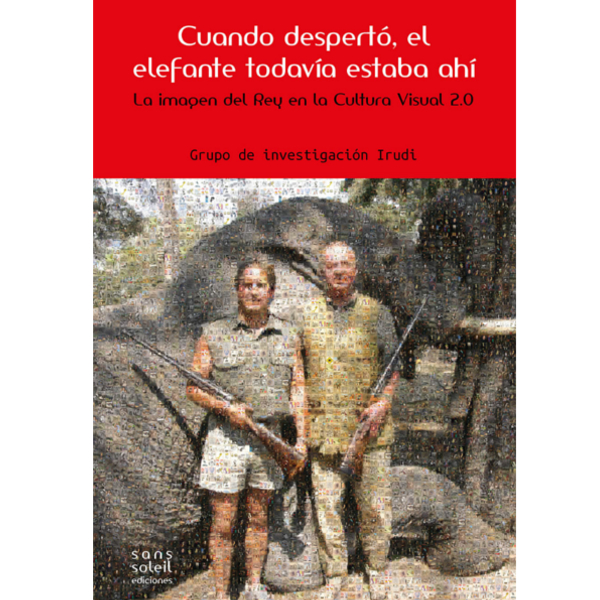
Book: Cuando despertó, el elefante todavía estaba ahí. La imagen del rey en la cultura visual 2.0
Authors
Ander Gondra
PhD. Marina Gutiérrez De Angelis
Gorka Lopez de Munain
Luis Vives-Ferrandiz
Publishing House Sans Soleil Ediciones
Year: 2014
Abstract
In April 2012, the photograph of King Juan Carlos with his rifle in his hand, next to a dead elephant, went around the world and was leaked for the first time in the press and the media in an unstoppable way. From then on, his person became the object of criticism, but also of mockery. The abdication, in terms of images, recovered and brought to light many of the arguments and criticisms that the monarchy as an institution had begun to feel since the last unfortunate acts of the monarch. Since the events of the elephant hunt in Botswana, not only the figure of the King but of the monarchy as an institution were put to the test. The deterioration of the figure of the monarch was increasing and the acceptance of the monarchy as an institution reported the lowest historical rates since the coronation of Juan Carlos I. We could say that this book addresses that deterioration marked by the period between the photos of the hunt and the various images about the abdication as a temporal arc
That is why this is a book written with the urgency and conditions that current events impose.
The image of the king has been –and continues to be– a central object of study for various disciplines, above all because of the singularities that its very nature entails and the challenge it imposes on us by involving concepts as complex as “presence” and “likeness”. It is a problem that completely transcends those representations that are usually considered as simple portraits. Undoubtedly the pictorial images of the king will be mentioned in this work, but the proposed approach urges us to understand his image from the perspective of an extended visual culture and not from its iconographic analysis
The portraits that accompany the monarch in Christmas speeches, official photographs, magazine reports, television appearances, etc., are perfectly calculated images aimed at the population with a clear purpose; but where is this purpose when the channels through which they end up being disseminated are outside the control of the monarchy? When the appropriability that characterizes the images of our time retouches, modifies and combines them?
After presenting a theoretical framework that allows us to trace some of the analytical keys to the subject, the book will have the famous elephant hunt in Botswana carried out by King Juan Carlos I –and its endless media consequences– as its backbone, to try to show that the study of images must be considered as one of the fundamental tools to understand the mechanisms that articulate and modulate the society in which we live.
Present and past thus merge into an anachronistic conglomerate where the hunts of medieval monarchs explain many of the hunting inclinations of King Juan Carlos I or the theories of English jurists of the Renaissance period about the two bodies of the king cement the questions about whether or not the monarch can have a private image. But, as we will see, these dialectical connections are never unidirectional; the past can help us understand the present and vice versa.

