
1st International Seminar on Visual Anthropology – FLACSO Ecuador
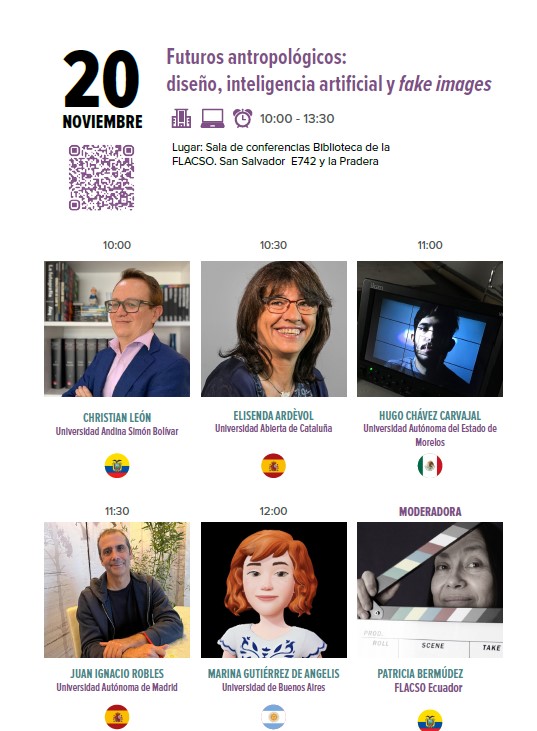
We appreciate the invitation to participate in the Seminar organized by the Master's Degree in Visual Anthropology of FLACSO Ecuador. A beautiful day of reflection on the new possibilities and challenges of Visual Anthropology in the contemporary context at the table Futuros antropológicos: Diseño, inteligencia artificial y fake images. Marina Gutiérrez De Angelis, one of the team members, participated with the conference
Virtual Reality, AI and new interdisciplinary perspectives in Visual Anthropology
Abstract
Virtual reality and artificial intelligence have opened new avenues of research in visual anthropology, along with the integration of interdisciplinary perspectives that incorporate contributions from cognitive neuroscience, digital humanities, design anthropology and UX-UI design. These new theoretical-methodological contributions have also incorporated new image media such as interactive and immersive experiences, photogrammetry, cinematic VR and digital environments, as well as tools for data visualization and processing
VR is transforming anthropological research through the design of immersive 3D environments that transform the way images are perceived and experienced, creating a scenario that goes beyond the traditional concepts of 2D visual anthropology. The sense of presence, complete insertion in space, embodied perception, are the key elements to understand how immersive experiences require new narrative strategies. On the other hand, the AI universe offers a wide variety of tools, from image generation to advanced data visualization and automated analysis that are being applied to anthropological analysis. These technologies are redefining how we understand and analyze, for example, visual data. As we move from optical-based realism to computational realism, it becomes essential to rethink our perception of images. AI-generated promptographies are the result of a complex process involving algorithms, data, and human interpretation. These images are not photographs, but interpretations generated by algorithms that explore new creative and visual possibilities.
This article aims to reflect on the opportunities and challenges arising from the integration of VR and AI in the field of visual anthropology. These technologies offer new tools for research; however, they also raise ethical and theoretical questions. A reflection is proposed on the interaction between visual anthropology and these digital tools, analyzing how this convergence generates a wide spectrum of opportunities and challenges that require a critical and in-depth analysis.

