
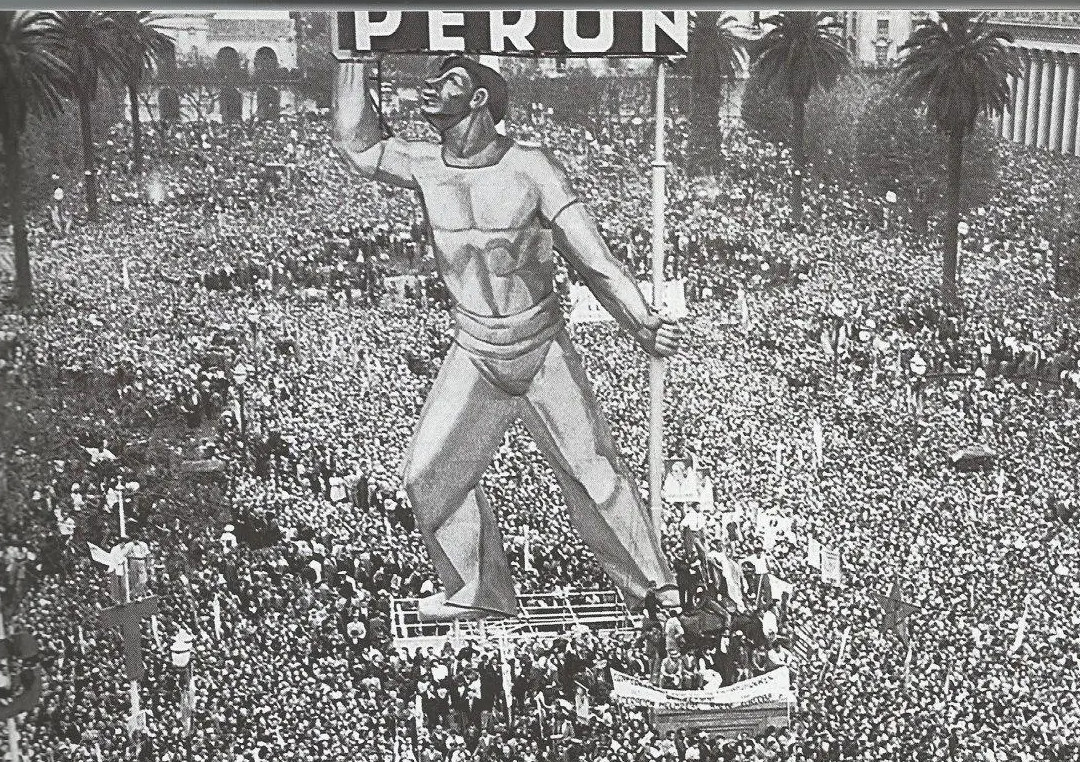
Latin American political iconography
Greta Winckler
contact: gwinckler[a]filo.uba.ar
Abstract
The relationship between image and politics has long been recognized within the academic world. Iconographic studies at the University of Hamburg more than two decades ago gave an account of the place that images occupy and the effects they create. The concern for the usefulness of sensitive representations of power questions the strategies of the image, its aesthetic-political dimension and the mechanisms of its staging. Following the philosopher Giorgio Agamben, men appropriate their exhibition and it is in the latter that the place of politics resides. That is, returning to the proposal of the art historian Horst Bredekamp, politics needs and produces images but is also oriented by images. The recovered European theoretical frameworks become vital because they place the image and its agentive capacity at the center of their thinking, that is, a proposal to think of them as acts of image. However, there is an element specific to the Latin American political matrix that escapes the thinkers of the global North in its specificity: the singular imbrication between body, politics, leadership and figuration. The popular movements that emerged, especially in South America in the 2000s, disrupted the prevailing power relations, not only in a concrete and local praxis, but in the very way of understanding politics, the state and its manifestations, even from a theoretical perspective. However, local iconographic studies are far from taking advantage of the fertile theoretical tools of Anthropology and Image Science to enrich them with the constellations of the global South. There is a dissociation between the most recent proposals of an Epistemology of the South and a commitment to extend it to the iconographic question, which does not ignore the German and French theoretical frameworks, but rather recovers and deepens them for the particular Latin American experience. The centrality of the body in the production of a local political thought and feeling requires a “patient” look at American visualities, which are also crossed by feminist and postcolonial mobilizations. Thinking about iconography in Latin America requires understanding the very complex interweaving of “traditional” political structures, including their inscription in the state – which in Europe has left a bitter taste of failure after May 1968 – and the social movements that since the 1960s have not stopped emerging and crystallizing their trajectories in multiple ways. The challenge in this project is to think about the totally haptic political experience of the global South from a theory of the image that understands it in its entirety and recovers the valuable studies of European political iconography, which cannot be dispensed with.
Publications
Conferencia anual de la Asociación Carl Justi 2022 Images by women artists. Gendering the Art Histories of Ibero-America and the Iberian Peninsula. Contexts – Narratives – Practices. Presentación: “Colonial Gazes, Patriarchal Gazes: (Counter) Proposals for an Emancipatory Imagination in the Work of Anna Bella Geiger and Guadalupe Miles” Warburg Haus – Hamburgo, Alemania. 5 y 6 de octubre, 2022
Winckler, Greta. Imagen, cuerpo y política. Proceso de zombificación en el gabinete nacional”, en Imágenes, cuerpos, dispositivos. Marina Gutiérrez De Angelis (ed.).Sans Soleil Ediciones Argentina, Buenos Aires 2019
González Silvina, Winckler, Greta “Alberto Fernández: el hombre de los puentes”, Laboratorio Analítico “Pensar a Alberto”. Acción Colectiva y Movimientos Sociales – Universidad Nacional de San Martín, Provincia de Buenos Aires 2019
Winckler, Greta. “Kicillove: la campaña del deseo. Iconografías ardientes en tiempos electorales”, (FSOC-UBA) | E-imagen Revista 2.0, Nº6, Sans Soleil Ediciones, España-Argentina. 2019
Winckler, Greta. “Un modelo perturbado(r). Reflexiones sobre la iconografía política peronista”| E-imagen Revista 2.0, Nº6, Sans Soleil Ediciones, España-Argentina. 2019
Bruno Paula, Winckler, Greta. “Del Atlas a la Calle. O cómo se desmonta la historia” en Russo, Sebastián (comp.) La imagen política. Buenos Aires:El ojo que mira el magma. 2019
Martinez Romagosa, Maite, Winckler, Greta. “Abriendo a la derecha. Un ensayo visual sobre el Mundial de Rusia 2018”, e-Imagen Revista 2.0, N°5, 2018
Winckler, Greta. “Lula como imagen-matriz en la visualidad política de Brasil” Dossier: Lula | e-imagen Revista 2.0, Nº.5, España-Argentina.2018
Bruno Paula, Winckler, Greta. «Imagen y violencia. La corporalidad de la mujer (en la) política” Actas de I Jornadas Internacionales Cuerpo y violencia en la literatura y las artes visuales contemporáneas. Filo UBA, Ciudad de Buenos Aires. 2017

